

Not so long ago following the tragic and heart-wrenching killing of three children at a children’s dance studio in Stockport, race riots were initiated around the UK as a result of both misinformation and intimidation by knuckle-dragging racists with too much time on their hands.
Depending on who and where you were, this was a terrifying time fraught with fear and anxiety. In the midst of this however, we saw thousands of anti-racist people show up, outnumbering the trash, to let the world know that they wouldn’t be dragged back to the overtly racist Britain of yesteryear. In the aftermath of it all there were plenty of cheers, self-congratulations and pats on the back in celebration of how Britain handled a very volatile situation.
For some people it looked like maybe, just maybe, there had been a shift.
People who had been attacked or who had had their property attacked knew better.
And then we went back to work.
In the days and weeks following, my social media feed was crammed with posts from minoritised people confused, disappointed, hurt and angry at the ‘business as usual’ approach of their non-minoritised colleagues in the aftermath of the riots. My friends and family further confirmed that they too had returned to work following the riots and no-one; not managers, colleagues or senior staff members had mentioned it. (Thankfully, this wasn’t my experience).
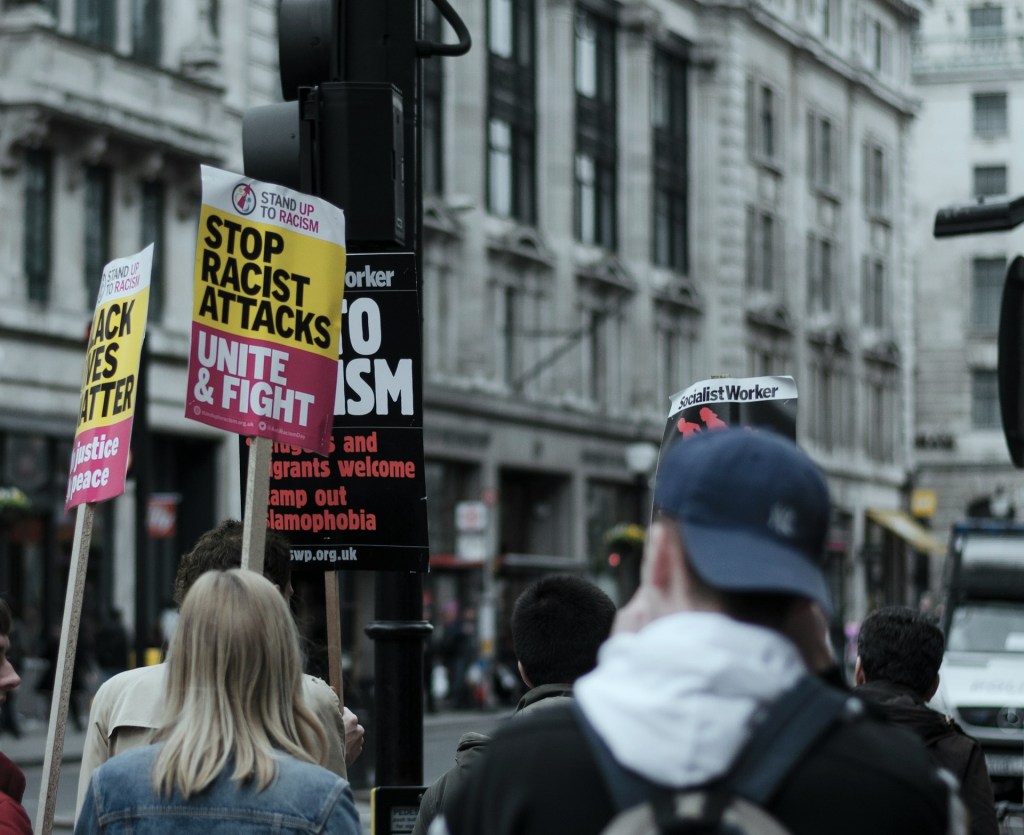
‘Why should they mention it?’ I hear some of you cry. Well, let me put it this way. I have, on many occasions in the work environment been witness to people enquiring about the health of, or offering their condolences over the death of a pet. I’ve even read articles by people suggesting that businesses should offer time off for vet appointments and the death of pets because for some people pets are part of the family. Personally, I have no opinion on this, but I do find it interesting (!) that without a second thought, people can enquire as to the health of a sick or dying pet belonging to a colleague, yet many of these same people couldn’t muster enough empathy to enquire about the wellbeing of their human black and brown colleagues and their loved ones in the midst of national racial tension resulting in violence and intimidation in many cities across the UK.
And this is just one of many reasons why, despite a ‘commitment to a fair and equitable workplace’ or whatever it is organisations slide into their literature to tick that EDI box, many employees will never feel psychologically safe in the workplace and thus cannot and will not bring their whole selves to work.
Here are five more reasons why:
Inauthenticity
Much organisational talk about inclusivity feels inauthentic. Talk of diversity, particularly as it pertains to race and disability always sounds more like: ‘What can we do to placate these people and avoid a PR disaster?’ instead of: ‘how can we create an environment where everyone feels valued, represented and heard?’ Ironically, the former further ‘others’ groups of underrepresented people who often feel like we are a problem that needs to be handled instead of valued members of staff whose needs should be met just like everyone else’s.
You still see difference as ‘other’
A lot of you are still deeply enmeshed in the process of ‘othering’ because you still haven’t learned not to centre yourself and your ideas of what constitutes ‘normal’. It’s because of this that your attempts at inclusivity feel more like charity. It’s giving: ‘look at me treating disabled people as if they’re actually people! I’m really good at this diversity stuff!’
Too many people still see white and able-bodied people as the ‘norm’ so when working alongside people who fall outside of this, you revert to assumptions and stereotypes that many don’t hide as well as they think they do.
A lack of grace
Can an employee with a disability make a simple mistake without people assuming they’re somehow less capable than their non-disabled colleagues? Is a request for reasonable adjustments really a person being difficult, or are you 1) too lazy to do what’s being requested of you, 2) too mired in stereotypes about people trying to ‘game the system’, or 3) ignorant of the fact that ‘unseen disabilities’ are a thing?
Similarly, is the black person who questions processes and or behaviours that aren’t quite right really so aggressive that they have to be reported to HR, or are you so blinded by stereotypes coupled with the shame of being called out about something you missed by someone you consider ‘less than’, that your true motivation is revenge?
Minoritised and disabled employees are less likely to receive grace than their non-minoritised and non-disabled counterparts meaning that any mistakes or misunderstandings usually not worth mentioning are highlighted and made into an issue if made by people from minoritised groups.

This lack of grace means that disabled and minoritised employees can never feel fully safe because we know that one simple mistake could cause a world of trouble for us. This tends to manifest itself in different ways such as: working longer hours for fear of being seen as lazy; seeking approval and over-explaining ourselves and/or our choices instead of using our initiative so as not to be accused of ‘over-stepping’; limiting our contributions for fear of saying the wrong thing, and more.
Needless to say, all of the above hinders development and makes for a miserable employee experience. For the individual, the constant stress and worry of having to, in some cases over perform can cause mental and physical ill health.
Blatant bias
Some of the friendliest, kindest, and most helpful people I have ever worked with were also the ones who were so clearly biased and were terrible at hiding it. There’s a fine line between connecting with people based on cultural sameness, and blatant favouritism based on the same. Such bias usually presents itself in such childish ways that it’s often dismissed by the people experiencing It because it feels ridiculous as an adult to verbalise the fact that your manager is more sensitive to the needs of team members closer to their cultural background, or that a manager or senior member of staff makes more of an effort to understand their white colleagues and their career objectives than colleagues of other backgrounds, even though there consequences of bias are very real. As minoritised members of staff, we see it and recognise it for what it is.
The great EDI Hijack
Many people who have never had to think about equity, diversity or inclusion because their privilege meant that they were never directly affected by inequity a lack of diversity or exclusion are the same people who have been given opportunities and platforms to lead entire EDI departments, strategies and discourse, and it’s going about as well as you’d expect.
These are the same people who never asked their minoritised colleagues how they were doing after the riots. They’re the same people who see EDI as another skill to acquire to propel them up the career ladder instead of an approach to life. Many lack the experience, empathy, courage and common sense needed to speak on such issues, and their risk-averse approach means that they are far more concerned with being called racist or ableist than they are with doing the right thing, hence, they keep quiet at times when they should be vocal in fear of ‘getting it wrong’.
Respectfully, these people are useless to the cause and often do more harm than good.
Meanwhile, the voices of experienced people who, for years have spoken out against discrimination in all its forms before it was ‘popular’ to do so, and were ripped to shreds as a result, have unsurprisingly been silenced. Presumably because their solutions require more than hosting social events for people of different backgrounds!
Hence why in most workplaces, very little has changed for minoritised and disabled employees.
***
My observations are based on being a regular, schmegular, non-managerial, black, visually impaired woman with albinism who has spoken to people, both witnessed and experienced discrimination, and worked in a variety of places pre and post EDI explosion or – as I refer to it, ‘The Great Awakening of 2020’. A time where, after literally hundreds of years of minoritised people speaking about the racism we experience all over the world, it only took being locked in our homes thanks to a global pandemic and footage of a man being murdered right in front of our eyes at the hands of a racist homicidal police officer (not for the first time!) for people to finally listen to and believe what we’ve been saying all along.

In my twenties I witnessed a manager – a good manager with years of experience who was excellent at their job – experience the most vile racial discrimination imaginable to the point where the organisation almost ruined the managers career.
I once worked in an environment where someone really felt it was okay to talk about the benefits of skin bleaching and the importance of having a fairer complexion.
I’ve worked in places where black members of staff received zero opportunities for career advancement and were actively blocked from trying to pursue any internal vacancies outside of facilities or administration.
I’ve worked in a place where an entire team refused to communicate properly with colleagues with a particular disability despite the fact that we worked for a charity that supported people with that same disability!
I could go on and on and on because I’ve seen, and experienced some nasty stuff.
And there are people who have seen and experienced worse things.
So, employers, senior managers etc, it’s nice that some of you would like people to ‘bring their whole selves to work’ but the likelihood of this happening when the environment is still hostile to the ‘whole selves’ of certain people, is poor.
If you want strong organisations you need strong teams and these don’t exist where there is no psychological safety. EDI is not one of those things you can have one foot in and one foot out of. Either be wholeheartedly committed to it in an authentic way, or leave it alone because anything else is just insulting.








Leave a comment